
Wondering how quantum computing vs classical computing really differ? You’d be forgiven for thinking one replaces the other. Classical machines use bits and quantum ones use qubits, but each suits different problems, so they’re expected to work together.
For the wider picture, start with our overview of quantum computing, then come back here for the head-to-head.
| Item | Value |
|---|---|
| Classical information unit | Bit: a definite 0 or 1 |
| Quantum information unit | Qubit: a superposition of 0 and 1 |
| Classical error rate | About 10^-17 per operation |
| Quantum error rate (current systems, April 2026 guide) | About 10^-3 to 10^-2 per operation |
| Google repetition-code error suppression (2021) | More than 100x lower logical error per round, from 5 to 21 qubits |
These figures come from The Quantum Insider’s April 2026 guide and Google Research’s listing of its 2021 Nature paper. Hardware keeps improving and the numbers can change, so check the sources before you rely on them.
What is the fundamental difference between quantum and classical computing?
Classical computers store information as bits, each in a definite state of 0 or 1, as The Quantum Insider’s April 2026 guide explains. Their operations are deterministic, so the same input and program give the same output every time.
Quantum computers use qubits, which can exist in superposition: a state that is simultaneously 0 and 1 with specific probability amplitudes, per the same April 2026 guide. For a closer look at the unit itself, see our explainer on what is a qubit.
When a quantum computation finishes, measurement collapses the superpositions into definite classical values. The outcome is probabilistic, so running the same algorithm twice can give different results, though the circuit design sets the probability distribution.
In short, the two differ in these ways:
- Unit: a bit is 0 or 1; a qubit can be a superposition of both.
- Output: classical results are deterministic; quantum results are a distribution of outcomes.
- Correlations: classical bits are linked only through explicit computation; qubits can be linked intrinsically through entanglement.
- Error rates: about 10^-17 per operation for classical, and about 10^-3 to 10^-2 for quantum systems, according to the April 2026 guide.
How classical computers work
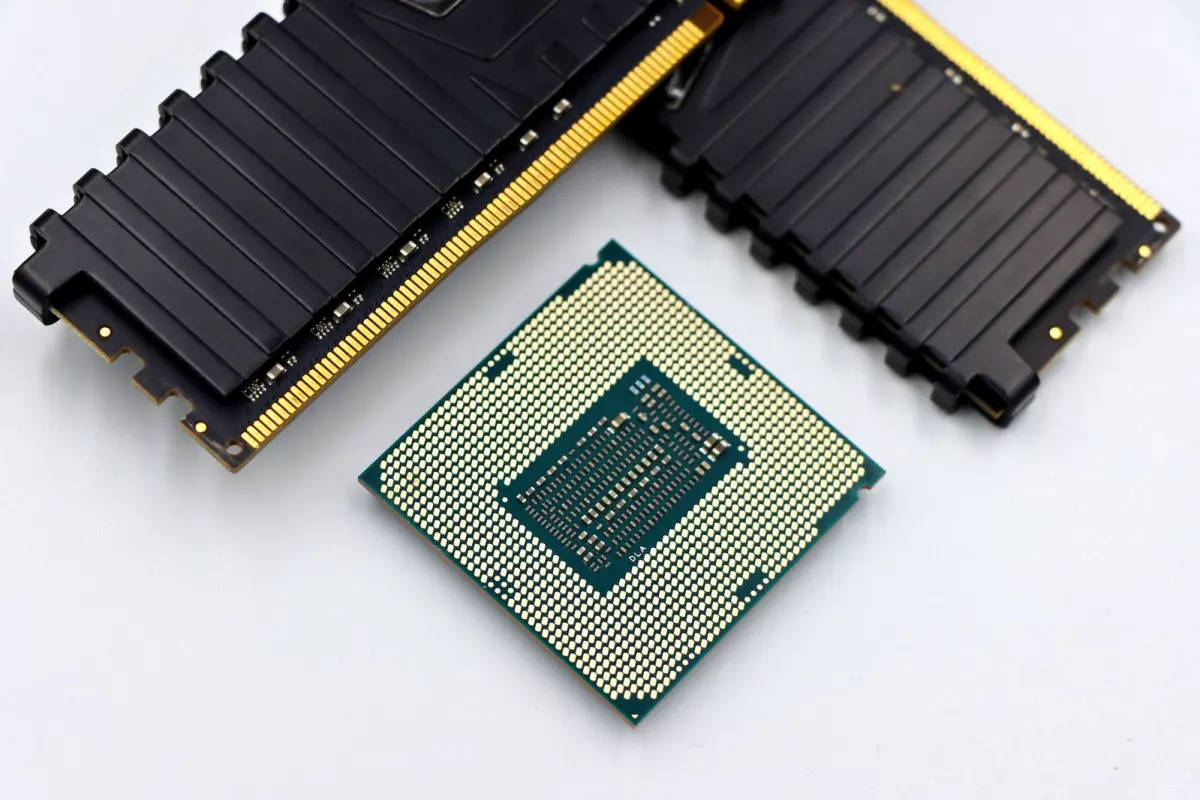
Most classical computers follow the von Neumann architecture. A CPU executes instructions and performs arithmetic and logic, memory holds both data and programs, and input/output systems connect to the outside world.
The machine runs a fetch-decode-execute cycle billions of times per second. It fetches an instruction, works out what to do, carries it out and stores the result.
Speed comes from several forms of parallelism:
- Multi-core processors put multiple independent CPUs on a single chip.
- GPUs use thousands of simple processors for parallel work on arrays of data, which suits matrix multiplication and machine learning.
- Distributed computing spreads a job across computers connected by networks.
Superposition, entanglement and interference
Three quantum properties give quantum computers their different character. Entanglement creates correlations between qubits, so the state of one depends on the state of others even if they are physically separated.
Interference lets an algorithm amplify the probability of correct answers while suppressing incorrect ones. Together with superposition, it steers the system toward the desired solution.
Classical computers lack these properties. Their bits are never both 0 and 1, and nothing in them amplifies correct answers through wave-like behaviour. To see how these properties become working hardware, our guide on how do quantum computers work covers the machines themselves.
Why error rates limit quantum computers
The biggest practical gap is reliability. IEEE Spectrum reported in July 2021 that state-of-the-art quantum platforms typically have error rates near 10^-3, while many practical applications call for rates as low as 10^-15, as covered in its Google error-suppression report.
The proposed fix is error correction. It spreads information across many physical qubits that together act as one logical qubit, so errors can be detected and corrected.
Google’s 2021 Nature work showed the idea can scale. Its repetition codes cut the logical error per round by more than 100x when going from 5 to 21 qubits, stable over 50 rounds, according to the Google Research paper page.
In September 2024, MIT Technology Review described a follow-up on Google’s Willow chips. A logical qubit made of 105 physical qubits suppressed errors better than one made of 72, and the logical qubit’s lifetime beat its best physical qubit by a factor of 2.4, per the MIT Technology Review report.
That report also carried a caution from IBM’s Jay Gambetta, who called the result just a first step. Physicist Kenneth Brown said useful algorithms need around a billion logical operations, and that no one was near that as of the September 2024 article, per the same report.
Researchers also disagree on the best route. A December 2024 piece in The Quantum Insider said IBM’s QLDPC code could, on paper, match a surface code that might need 4,000 qubits using just 288.
As of The Quantum Insider’s April 2026 guide, quantum computers sit in the NISQ era, with error rates millions of times higher than classical processors. The guide says they need fault-tolerant error correction and millions of physical qubits before they can consistently outperform classical supercomputers on practical applications.
Which problems suit each kind of computer?
Classical computers excel at the vast majority of everyday computing, per the April 2026 guide. That covers:
- running operating systems
- processing transactions
- rendering graphics
- executing machine learning algorithms
- managing databases
Quantum computers are highly specialized. The guide names molecular simulation, factoring and some optimization tasks as problems where they can be far more efficient, while for almost everything else classical machines stay faster, cheaper and more reliable.
So the relationship is complementary rather than competitive. The guide expects hybrid setups in which classical computers handle most workloads and quantum processors tackle specific bottlenecks.
Headlines about quantum machines “beating” supercomputers can mislead for this reason. The two are different computational models, not faster and slower versions of one thing.
Frequently asked questions
Will quantum computers replace classical computers?
Show answer
Not according to The Quantum Insider’s April 2026 guide, which expects quantum computers to act as specialised co-processors for narrow problem classes rather than general-purpose replacements.
Is a qubit just a bit that is both 0 and 1?
Show answer
Not quite. A qubit can hold a superposition with specific probability amplitudes, and measurement then collapses it to a definite value, so the result is probabilistic.
Why are quantum computers so error-prone?
Show answer
MIT Technology Review’s September 2024 report says errors creep in because the components are so sensitive. A physical state is easy to alter by accident, and the errors accumulate over time.
Are quantum computers faster at everything?
Show answer
No. They can be far more efficient on certain problems, but for almost everything else classical computers remain faster, cheaper and more reliable, per the April 2026 guide.