Wondering what quantum computing actually is, and whether it matters to you? It’s a way of computing that uses superposition, entanglement and interference to tackle certain problems classical machines can’t efficiently handle. Here’s the plain-language map.
| Item | Value |
|---|---|
| Foundational ideas proposed | Early 1980s (Feynman, Deutsch) |
| Shor’s algorithm discovered | 1994 |
| Grover’s search algorithm | 1996 |
| Surface-code error tolerance | Physical error rates below roughly 1% |
| Surface-code overhead | On the order of a thousand physical qubits per logical qubit |
| Superconducting qubit operating temperature | Millikelvin range |
These figures come from IEEE’s Technology Navigator pages on quantum computing and its topic area, which carry a 2026 copyright notice. Figures like these can change as research moves on, so check the source before you rely on them.
What is quantum computing?
Quantum computing is, in IEEE’s words, a computational paradigm that uses quantum-mechanical phenomena, specifically superposition, entanglement, and interference, to process information in ways classical digital computers cannot efficiently replicate (IEEE TechNav). The physics underneath it is covered in our guide to quantum mechanics. The field also draws on computer science, information theory and materials engineering.
It is not simply a faster version of the laptop on your desk. The promise is narrower: for certain problem classes, a quantum machine can scale far better than any known classical method. If you want the side-by-side picture, our explainer on quantum computing vs classical computing goes into it.
A short history
The ideas are older than most people expect. Three milestones stand out:
- Early 1980s: Richard Feynman proposed that quantum systems could most naturally simulate other quantum systems, and David Deutsch defined the quantum Turing machine (IEEE TechNav). A second IEEE page also names Paul Benioff among the researchers who laid the foundations in the 1980s (IEEE TechNav area page).
- 1994: the discovery of Shor’s algorithm, which factors large integers in polynomial time on a quantum computer (IEEE TechNav).
- 1996: Lov Grover’s search algorithm, which together with Shor’s showed that quantum computation could offer asymptotic advantages for specific problems (IEEE TechNav).
Qubits, superposition and entanglement
The fundamental unit is the qubit. Unlike a classical bit, it can exist in a linear combination of the states |0⟩ and |1⟩ until it is measured (IEEE TechNav). Our short explainer on what is a qubit builds this up from scratch.
That combination is called superposition. IEEE describes how a register of n qubits can represent 2ⁿ states simultaneously, which lets algorithms manipulate the whole distribution at once (IEEE TechNav). This is not the same as getting every answer for free, because the trick is in how an algorithm shapes the result.
The second ingredient is entanglement. Multiple qubits can be entangled so that operations on one affect the state of others in correlated ways (IEEE TechNav area page).
The third is interference. Quantum algorithms exploit it to amplify probability amplitudes for correct answers while canceling amplitudes for wrong ones (IEEE TechNav).

Gates and circuits: how a computation is written
Quantum computation is typically described in the quantum circuit model. A computation is a sequence of quantum gates applied to an initial qubit state (IEEE TechNav area page). Our guide to quantum gates covers the common ones in more detail.
Two broad kinds of gate do most of the work:
- Single-qubit gates rotate the qubit state on the Bloch sphere.
- Two-qubit gates, such as the CNOT and controlled-Z, create entanglement between pairs of qubits.
Any quantum computation can be decomposed into a universal gate set made up of a small number of gate types. The circuit model also acts as an abstraction layer, so algorithm designers can describe computations without naming the physical qubit platform (IEEE TechNav area page).
For a fuller walk-through of the machine itself, see how do quantum computers work. As a neutral example of a software tool, IEEE’s page notes that IBM’s open-source Qiskit framework provides a widely used environment for implementing both circuit-based and variational algorithms.
Qubit hardware: competing ways to build one
Several physical technologies compete to realise qubits, each with its own trade-offs in coherence time, gate fidelity and scalability (IEEE TechNav). Our overview of the types of qubits compares them. In brief:
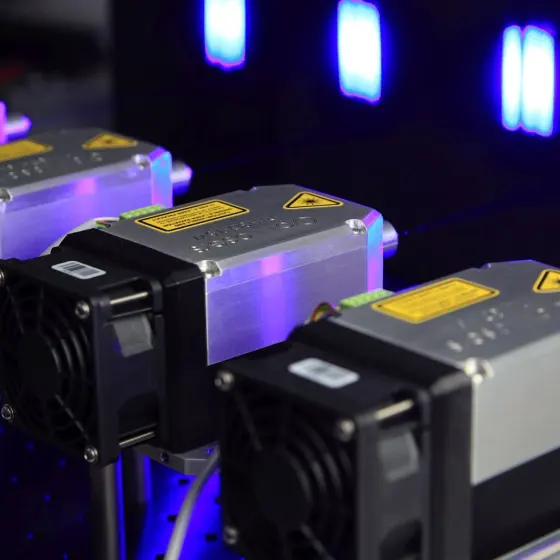
- Superconducting circuits: used by IBM, Google and others, they operate at millikelvin temperatures and offer fast gate times in the nanosecond range, but need extensive cryogenic infrastructure.
- Trapped ions: high two-qubit gate fidelities and long coherence times measured in seconds, at the cost of slower operations.
- Photonic qubits: naturally suited to communication links and able to operate at room temperature.
- Neutral atoms: held in optical tweezer arrays, they offer flexible all-to-all connectivity via Rydberg interactions.
- Spin qubits in semiconductors: another platform named on IEEE’s topic-area page.
The second IEEE page adds that superconducting qubits have been the dominant platform for large-scale experimental systems because their fabrication leverages existing semiconductor manufacturing processes (IEEE TechNav area page). Trapped ions, by contrast, face challenges in scaling to large numbers of ions with individual addressability.
One idea ties all of these together: coherence time, the duration over which a qubit maintains its quantum state. It sets a hard upper limit on how deep a circuit can be executed reliably (IEEE TechNav).
Quantum algorithms: where the speedups come from
An algorithm only helps if it turns the physics into a useful answer. IEEE highlights four families, each aimed at a different kind of problem:
- Shor’s algorithm uses the quantum Fourier transform to find the period of a modular arithmetic function, reducing integer factorization to a problem quantum hardware can solve efficiently (IEEE TechNav). Read more in our piece on shor’s algorithm.
- Grover’s algorithm searches an unstructured database of N items in O(N^(1/2)) operations, a quadratic improvement over classical exhaustive search (IEEE TechNav area page).
- Variational eigensolver (VQE) and the quantum approximate optimization algorithm (QAOA) use shallow circuits and classical optimization loops, targeting near-term hardware for chemistry and combinatorial optimization.
Shor’s algorithm matters beyond theory: IEEE’s area page describes it as threatening public-key cryptography. That is why it motivates post-quantum cryptography standards.
A fair question is when any of this beats classical computers in practice. The IEEE TechNav area page, which carries a 2026 copyright notice, says engineering is now producing systems with enough qubits and low enough error rates to demonstrate early quantum advantage on selected problems (IEEE TechNav area page). Our guide to quantum advantage explains what that phrase does and does not claim.
Why errors are the central engineering problem
Physical qubits are inherently noisy, losing coherence through relaxation and dephasing (IEEE TechNav). Useful computations need error rates far below what today’s hardware achieves, so the field relies on quantum error correction. Our explainer on quantum error correction gives the full picture.
The core idea is to encode one logical qubit across many physical qubits. Syndrome measurements then detect errors without collapsing the logical state (IEEE TechNav).
The surface code and its cost
The surface code is the most widely studied scheme because it requires only nearest-neighbor interactions and has a favorable error threshold (IEEE TechNav area page). It tolerates physical error rates below roughly 1%, but at practical noise levels it needs on the order of a thousand physical qubits per logical qubit (IEEE TechNav).
The threshold theorem is the reason for optimism. It guarantees that arbitrarily long computations become feasible if per-gate error rates fall below the code threshold, provided errors are sufficiently independent.
IEEE’s area page cites Google’s Nature paper on below-threshold surface code operation. It demonstrated that adding more physical qubits per logical qubit reduced logical error rates, a prerequisite for fault-tolerant quantum computation (IEEE TechNav area page). Devices that precede full fault tolerance are known as noisy intermediate-scale quantum (NISQ) hardware.
Applications, and how to read the headlines
Quantum computing is being explored across science and industry, and the word “explored” is deliberate. IEEE lists these areas (IEEE TechNav area page):
- Cryptography: Shor’s algorithm motivates post-quantum standards, and quantum key distribution offers information-theoretic security.
- Drug discovery and molecular simulation: quantum systems naturally represent electronic structure.
- Optimization: logistics, portfolio balancing and network routing are candidates for speed-ups.
- Machine learning: quantum kernel methods and sampling algorithms may accelerate specific tasks.
- Materials science and climate modeling: simulating strongly correlated electrons and accelerating fluid and atmospheric simulations.
Notice the cautious verbs: “may”, “candidates”, “can in principle”. When you read a bold claim, a few questions help you judge it:
- Is the claim about a specific problem, or about computing in general?
- Does it mention error rates and coherence time, not just the number of qubits?
- Does it say whether the hardware is noisy, or fault tolerant?
- Is there a primary source you can check?
Quantum computing is one strand of a wider family of devices and methods. For the bigger picture, including how it sits beside networks and sensing, see our overview of quantum technology.
Frequently asked questions
What is quantum computing in simple terms?
Show answer
It is a model of computation that uses superposition, entanglement and interference to process information. For certain problem classes, it can scale better than any known classical approach, according to IEEE’s Technology Navigator.
Is a quantum computer just a faster normal computer?
Show answer
No. Its advantage is specific to certain problems, such as integer factoring, unstructured search and quantum system simulation. For many everyday tasks, it offers no such benefit.
Will quantum computers break encryption?
Show answer
IEEE describes Shor’s algorithm as threatening public-key cryptography, and it motivates post-quantum standards. Breaking real-world encryption would need fault-tolerant machines, which rely on the error correction described above.
What does NISQ mean?
Show answer
It stands for noisy intermediate-scale quantum. It describes devices that precede full fault tolerance, so errors still limit how deep their circuits can be.