Wondering whether light is a wave or a particle? Wave-particle duality says it is both: light and matter show wave or particle behavior depending on the experiment you run. You don’t have to pick a side.
This page sits inside the wider topic of quantum mechanics, where duality is one of the founding puzzles.
| Item | Value |
|---|---|
| Thomas Young first describes the double-slit experiment | 1801 |
| Planck’s law challenges the wave model of light | 1901 |
| Einstein interprets the photoelectric effect with photons | 1905 |
| Compton’s experiments on the momentum of light | 1922 to 1924 |
| Electron wave behavior demonstrated (Davisson-Germer, Thomson and Reid) | 1927 |
| Molecules sent through a double slit | 2000 atoms each (25,000 daltons) |
These dates and figures come from Wikipedia’s double-slit experiment article and a Wikipedia mirror of its wave-particle duality article. Figures can change as sources are revised, so check the source before you rely on them.
Wave-particle duality begins: how the wave picture won first
In the late 17th century, Isaac Newton argued that light was made of particles, while Christiaan Huygens took the opposing wave approach, as the Wikipedia mirror describes it. The wave side then gained ground through two experiments.
Thomas Young described his interference experiment in 1801, as Wikipedia’s double-slit article notes. In 1819, François Arago’s detection of the Poisson spot added support to Huygens’ wave models, per the same mirror.
To see why this mattered, it helps to separate the two classical pictures:
- Classical waves interfere: they overlap, add up and cancel out.
- Classical particles follow trajectories: in the absence of forces, straight lines.
- Unlike waves, particles do not exhibit interference.
Why light also behaves like a particle
The wave model was challenged in 1901 by Planck’s law for black-body radiation, according to the Wikipedia mirror. Three steps then pushed physics toward a particle side of light:
- 1901: Max Planck derived a formula for the black-body spectrum by assuming an oscillator could only change its energy in minimal increments tied to frequency.
- 1905: Einstein interpreted the photoelectric effect using discrete energies for photons.
- 1922 to 1924: Arthur Compton ran experiments demonstrating the momentum of light.
The photon theory stayed controversial until Compton’s work, even after other experiments confirmed it. His results seemed to contradict the earlier evidence of wave-like interference, and that tension is what the name duality was coined to describe.
A physics course from comPADRE’s Physlet Quantum Physics puts it plainly: light, classically considered a wave, sometimes behaves like a particle called a photon.
What the double-slit experiment shows
In the basic version, a coherent light source such as a laser illuminates a plate with two parallel slits, and you watch the screen behind it. One classroom photograph shows light from a green laser passing through slits 0.1 millimeter wide and 0.4 millimeter apart, per Wikipedia.
The light from the two slits interferes, producing bright and dark bands. That is a result that would not be expected if light consisted of classical particles.
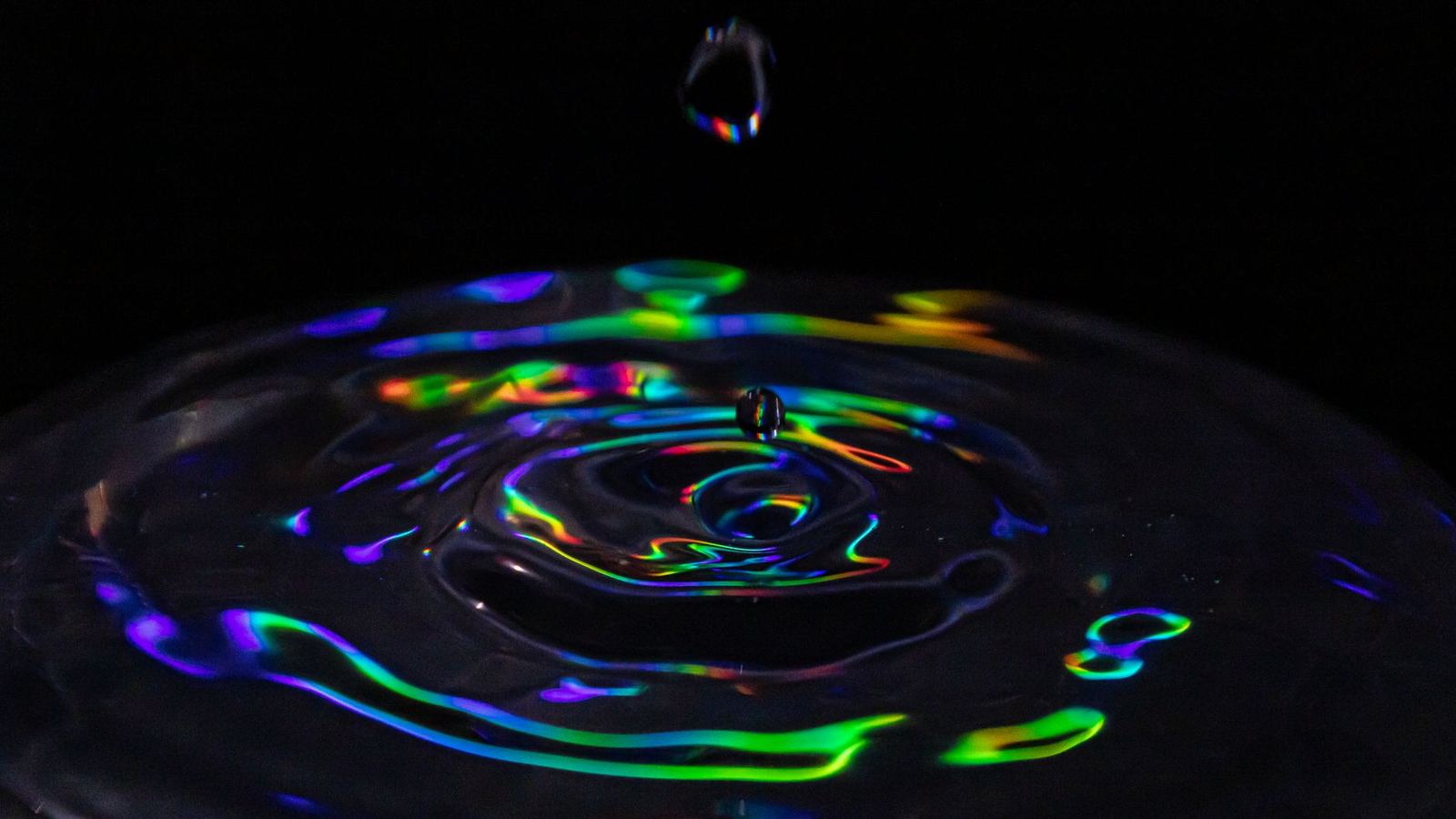
Yet the light is always found to be absorbed at the screen at discrete points, as individual particles. The interference pattern appears only through the varying density of those hits, as Wikipedia’s article explains.
Then comes the twist. When detectors are placed at the slits, each detected photon passes through one slit, as a particle would, and not through both. In those versions the pattern instead becomes the sum of two single-slit patterns, so the interference disappears, according to the same article.
Richard Feynman described the experiment as a phenomenon impossible to explain in any classical way, one that “has in it the heart of quantum mechanics,” as quoted on Wikipedia.
Do electrons and bigger objects act like waves?
Yes, and the story ran in the opposite direction for matter. Electrons were first shown to have particle properties, and then wave-like aspects. In 1924 Louis de Broglie introduced his theory of electron waves in his PhD thesis, per the Wikipedia mirror.
The experimental proof followed in 1927, when Davisson and Germer and, independently, George Paget Thomson and his research student Alexander Reid showed that electrons give the same interference behavior, according to Wikipedia. That behavior was later extended to atoms and molecules.
The experiment can be done with entities much larger than electrons, although it gets harder as size increases. Two examples from the same source:
- Molecules that each comprised 2000 atoms, with a total mass of 25,000 daltons.
- Nanoparticles composed of 5000-10000 sodium atoms.
The comPADRE chapter describes the same idea in general terms: the electron, classically described as a particle, sometimes behaves like a wave.
What duality does and doesn’t mean
Wave-particle duality is the concept in quantum mechanics that quantum entities exhibit particle or wave properties according to the experimental circumstances, as the Wikipedia mirror puts it. It does not claim that light is secretly a tiny ball with a wavy tail. It expresses the inability of classical concepts such as particle or wave to fully describe quantum objects.
In the mirror’s wording, quantum systems obey wave equations that predict particle probability distributions. That is why single hits look random while the overall pattern is smooth and predictable.
The double-slit result can be read in more than one way. The copenhagen interpretation is one of several readings, alongside relational, many-worlds and de Broglie-Bohm accounts listed in Wikipedia’s double-slit article.
Duality also connects to a famous limit on knowledge. As the comPADRE text frames it, the position and the momentum of a particle cannot both be known precisely at the same time, a point you can explore further in this explainer on the heisenberg uncertainty principle.
Frequently asked questions
Is light a wave or a particle?
Show answer
Both descriptions are needed. Light shows wave behavior in interference and particle behavior when it is absorbed at discrete points on a screen, according to Wikipedia’s double-slit article.
Does looking at which slit change the result?
Show answer
Yes. When detectors reveal which slit a particle passes through, the double-slit interference pattern is not formed, and the pattern becomes the sum of two single-slit patterns.
Do only tiny things show wave behavior?
Show answer
No. The double-slit experiment has been performed with molecules of 2000 atoms, though it becomes more difficult as size increases.
Who first showed that light behaves as a wave?
Show answer
Thomas Young described the double-slit experiment in 1801 while making his case for the wave behavior of visible light, per Wikipedia.